




Back to ICJN

Biofeed Science and Technology (BST)

Agricultural Science

Biofeed Science and Technology (BST) is based on the health concept of “creating a better life through biotechnology”, promoting the coordinated development of animal production,  biotechnology, and human life. 

BST offers APC waivers before December 31,2029.


Published in Partnership with

Aims & Scope

Biofeed Science and Technology (BST) focuses on interdisciplinary fields related to biotechnology, covering the entire research chain including innovation and development of biological resources, development and resource utilization of green raw materials, optimization of fermentation technology and processes, detection and evaluation and data application, intelligent feeding technology and equipment, and application effect research; set up a special column for review and outlook, technical exchange, and case studies to systematically promote the latest developments in biotechnology to improve the quality of livestock products, while providing technical support for industrial practice.

Latest Articles

View more
Graphical abstract
272

Efficient Fermentation of Rhodotorula glutinis and Chlorella vulgaris Composite Feed Additives and Construction of Novel Microcapsule Carriers for Enhancing Carotenoids Stability and Bioaccessibility

Cunyong Qin, Jingjing Wu, Chi Zhang, Tianxiao Li, Mengzhuo Yang, Shiqi Li, Zhiping Zhang, Lijing Jiao

Mixed-culture products of Rhodotorula glutinis and Chlorella vulgaris can enhance the antioxidant capacity of target organisms. However, their intrinsic carotenoids exhibit poor stability and bioaccessibility, which hinders the industrial application of related functional feeds. In this study, yeast-algal cells harvested from a 5 L fermenter were double-coated with gelatin and gum arabic. Process parameters were optimized by single-factor experiments and response surface methodology (RSM). Encapsulation efficacy was characterized by zeta potential analysis, Fourier transform infrared (FT-IR) spectroscopy and scanning electron microscopy (SEM). The results showed that the maximum encapsulation rate reached 65.87% at the optimal conditions: wall material concentration of 1.34%, core-to-wall ratio of 58.80%, gelatin proportion in wall materials of 35.40% and curing agent addition of 0.17%. Characterization revealed that re-crystallization-regulated zeta potential facilitated the formation of dense wall structures. Storage stability tests demonstrated enhanced antioxidant retention, and in vitro digestion assays verified favorable sustained-release properties. This study effectively improves carotenoid stability and bioaccessibility, providing technical support for high-performance feed additives.
Graphical abstract
424

Citrus Processing By-Products and Their Phytochemicals in Ruminant Nutrition: From Rumen Modulation to Animal Performance, Product Quality, and Environmental Sustainability

Yuchao Zhao, Linshu Jiang

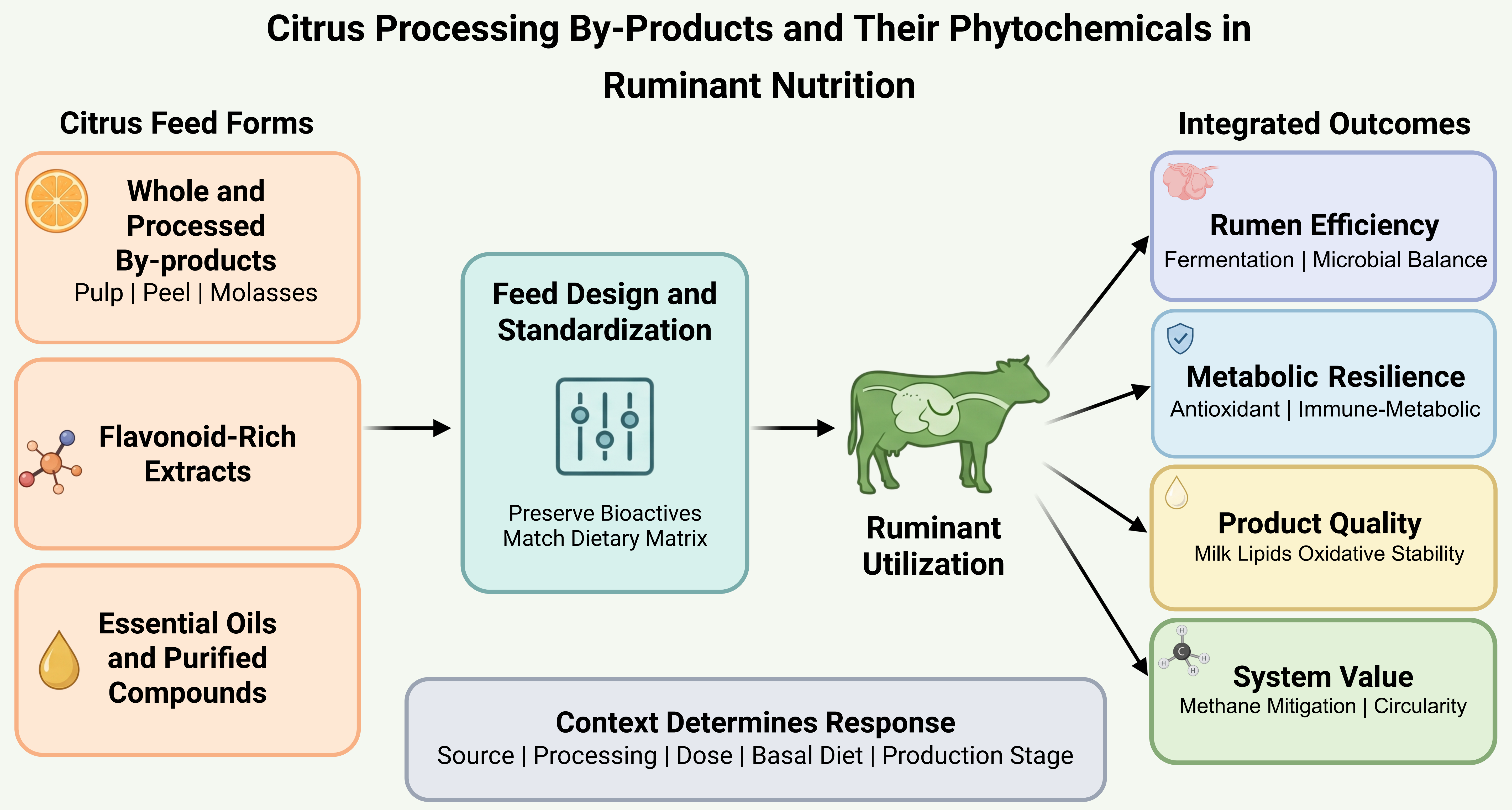
Citrus processing generates substantial quantities of peel, pulp, membranes, seeds, and extraction residues that present both a waste-management challenge and a potential resource for ruminant production. These by-products are characterized by a fermentable nutritional matrix rich in pectin and soluble sugars, together with diverse phytochemicals, including flavanone glycosides, polymethoxylated flavones, essential oils, phenolic acids, carotenoids, and limonoids. This review critically examines how interactions between these nutrients and phytochemicals affect rumen fermentation, microbial ecology, animal performance, metabolic health, product quality, and environmental sustainability. Citrus pulp can partially replace cereal-based concentrates and provide rapidly fermentable energy with relatively low lactate production. However, responses depend on inclusion level, basal diet, processing method, by-product composition, animal species, and production potential. Citrus flavonoids and essential oils may modulate rumen microorganisms, methanogenesis, nitrogen metabolism, oxidative balance, and inflammatory regulation, although evidence from high-dose in vitro studies cannot be directly extrapolated to whole by-products or commercial production. Citrus-derived interventions may also modify milk and meat fatty-acid profiles, antioxidant capacity, oxidative stability, sensory properties, and shelf life, but results remain heterogeneous. From a circular bioeconomy perspective, feeding citrus residues can divert organic material from disposal and reduce reliance on human-edible feeds. Nevertheless, drying, extraction, transportation, reduced animal productivity, and alternative residue uses may offset these benefits. Overall, citrus by-products should be considered integrated nutrient-phytochemical matrices rather than uniform feed ingredients. Standardized chemical characterization, long-term dose-response studies, mechanistic multi-omics research, and combined life-cycle and techno-economic assessments are required to support their safe, effective, and environmentally credible use in ruminant production systems.

Graphical abstract
272

From Spent Mushroom Substrate to Biofeed: Source Heterogeneity, Dual Cell-Wall Barriers, and Targeted Bioprocessing

Hongyu Chen, Ying Wang, Bing Li, Youran Shao, Gen Zou

Background: Industrial mushroom cultivation generates large, concentrated quantities of spent mushroom substrate (SMS), but SMS is not a uniform feed ingredient. Mushroom species, the original substrate, the cultivation cycle, and storage history all influence its nutrient content, safety, digestibility, and sensory properties. Purpose: This review examines SMS as a biofeed resource and asks how different sources can be made safer, more digestible, and more acceptable to animals. Methods: This critical narrative review integrates source-characterisation studies, mechanistic evidence, and animal-feeding trials, giving greater weight to studies that report SMS source, treatment, and dietary inclusion. Results: SMS retains lignocellulose, fungal biomass, protein, minerals, and bioactive metabolites. Its feeding value is limited by two distinct structural materials: residual plant cell walls and newly formed fungal walls containing chitin, beta-glucans, and mannoproteins. Mushroom volatiles, bitter compounds, high water-holding capacity, ash, and storage spoilage may further reduce intake. Feeding studies support moderate roughage replacement in ruminants and rabbits and low-dose functional use in pigs, poultry, and tilapia, but the response depends strongly on source, treatment, dose, and diet formulation. Conclusions: A more practical approach is to identify what limits each batch and then decide whether it can be used directly, preserved, treated with enzymes, fermented with selected cultures, or kept out of feed. A provisional four-grade research hypothesis is proposed to organise feed suitability and treatment requirements; it is intended for future validation rather than as an established feed standard. The practical question is which material can be used, for which animal, at what inclusion level, and after what treatment.

Graphical abstract
209

Effects of Sodium Diformate on Immune Organs, Inflammatory Cytokines, Intestinal Morphology, and Cecal Microbiota of Hy-Line Brown Laying Hens

Zongfu Li, Qiunan Chen, Yang Luo, Weiwei Li

Background: Organic acidifiers are promising alternatives to in-feed antibiotics, but the effects of sodium diformate (NaDF) on intestinal health and cecal microbiota in laying hens remain unclear. Objective: This study aimed to investigate the effects of dietary NaDF supplementation on immune organ indices, pro-inflammatory cytokines, intestinal morphology, and cecal microbiota in Hy-Line Brown laying hens. Methods: A total of 720 twenty-one-week-old hens were randomly assigned to 6 groups (6 replicates of 20 hens each). Hens were fed a basal diet supplemented with 0 g/kg, 1 g/kg, 2 g/kg, 3 g/kg, 4 g/kg, or 5 g/kg NaDF for 24 weeks following a 1-week pre-feeding period. Results: Dietary NaDF supplementation showed no significant effect on spleen coefficient or the expression of pro-inflammatory cytokines across intestinal segments (P > 0.05). Notably, 1 g/kg to 4 g/kg NaDF significantly increased duodenal villus height (P < 0.05). The ratio of villus height to crypt depth was not significantly affected, with a linear increasing trend observed (P < 0.05), peaking at 4 g/kg. Ileal villus height was significantly increased (P < 0.05), with linear and quadratic responses (P = 0.028, P = 0.004). Cecal microbiota analysis revealed no significant changes in α diversity or microbial composition at the phylum level (P > 0.05). However, supplementation with 4 g/kg NaDF significantly reduced the abundance of Parabacteroides and Mordavella massiliensis (P < 0.05), while Alistipes and Prevotella showed increasing trends (P = 0.083, P = 0.055). Conclusion: Dietary NaDF supplementation improved duodenal and ileal morphology and exerted minor effects on specific bacterial genera, thereby promoting intestinal health in laying hens. However, it did not significantly affect the spleen index or inflammatory cytokine expression. The 4 g/kg level showed the most consistent improvements in intestinal morphology.

Graphical abstract
255

Characterization of a Novel CotA-Type Laccase from the Safe Bacillus velezensis T-3 Via Genome Analysis, Quantitative Proteomics and Molecular Docking

Jiali Su, Yanhong Cao, Ngo Dinh Tan, Miao Liang, Qianyi Chen, Shasha Luo, Fengdie Huang, Xuewen Chen, Dong Luo, Caixia Zou, Xinghua Cai

Laccase is a class of known copper-dependent oxidase which can antagonize molds and degrade mycotoxins efficiently, but few reports exist on the structure and function of laccase from Bacillus velezensis. In this study, we identified a CotA-type laccase gene (locus tag: ctg_03438) in B. velezensis T-3, and its DON removal capacity was investigated via bioinformatics analysis, 4D-DIA quantitative proteomics, and in vitro fermentation assays. Results indicated that the CotA gene encodes an extracellular spore coat protein (CotA) that lacks typical signal peptides and transmembrane domains. Crucially, 4D-DIA quantitative proteomic analysis confirmed that CotA in B. velezensis T-3 is expressed at a high level, with 23 unique peptides covering 47.30% of the protein sequence, including a strictly proteotypic peptide (PLKEADTSRK). Molecular docking revealed a stable DON-CotA interaction (ΔG = -6.299 kcal/mol) with a 6.4 Å distance to the T1 copper center, suggesting a potential binding mode for DON recognition. Functionally, B. velezensis T-3 demonstrated potent antifungal activity (inhibition zone: 3.51 cm against Fusarium graminearum (F. graminearum)) and achieved a 30.06% reduction of DON in contaminated feed within 10 days. This study provides a safe candidate strain and molecular-level evidence for the development of biodetoxification agents.