


Back to ICJN

Cytotherapy and Longevity (CL)

Medicine-Health

Cytotherapy and Longevity (CL),  adhering to its core mission of "promoting human health and functional longevity through cell therapy," is committed to advancing collaborative innovation in cell therapy, mechanobiology, and the prevention and treatment of degenerative diseases. 

CL offers APC waivers before December 31,2029.


Published in Partnership with

Aims & Scope

Cytotherapy and Longevity (CL) focuses on the multidisciplinary field of cell therapy related to human aging, covering the entire industry chain of research, including various cell types from different sources and their mechanobiological regulatory mechanisms, the development and clinical translation of cell therapies targeting multiple frailty-related diseases, cell culture and process optimization using physical regulation techniques in a mechanobiological microenvironment, cell function testing and the application of clinical efficacy data, the development of intelligent mechanobiological intervention technologies and equipment, and the validation of the efficacy of cell therapy in degenerative diseases. It also promotes the translational application of innovative technologies from kinetic medicine, mechanics, biomechanics, and mechanobiology in combined mechano-immuno-regenerative therapies. To comprehensively present the latest achievements and development trends in this field, CL will feature special columns such as reviews and outlooks, technical exchanges, and case studies to gather cutting-edge perspectives and practical experiences from scholars both domestically and internationally; systematically introduce the latest advances in cell therapy in delaying physical decline, enhancing motor function, and improving quality of life; and provide technical support for related clinical practices and industrial development.

Latest Articles

View more
Graphical abstract
322

Regulatory Evolution and Transformation of China's Cell and Gene Therapy Industry

Wei Li, Zhen Qin, Xiujuan Wang, Xiu'e Wang, Jing Wen, Yichen Shi, Chunlin Mou

Cell and gene therapy (CGT) products have driven a global transformation in medicine, opening new avenues for the diagnosis and treatment of major diseases, while also posing new challenges to regulatory agencies worldwide. In the context of the current global CGT industry landscape, this article systematically reviews the evolution of China's CGT regulatory framework over the past three decades, delves into the stages of regulatory development, and analyzes the profound impact of regulatory policies in different periods on the industry landscape, biopharmaceutical research and development (R&D) activities, and clinical translational application. At present, China ranks among the global leaders in the number of CGT pipelines under development, demonstrating strong momentum for industrial growth. However, under the conventional regulatory paradigm, challenges such as long R&D cycles, inefficient translational application pathways, and unclear delineation of authorities and responsibilities have long constrained the development of the industry. On this basis, this article interprets the Regulation on the Administration of Clinical Research and Clinical Translational Application of New Biomedical Technologies, which entered into force in 2026, with a particular focus on its new dual-track regulatory framework that comprises a drug registration pathway and a new biomedical technology pathway, and its transformative impact on regulatory approval procedures, clinical translational application, and full lifecycle risk management.

Graphical abstract
290

Effects of Antidiabetic Drugs on Longevity and Healthspan: Evidence and Controversies From Glucose-Lowering Therapy to Anti-Aging Intervention

Xuancheng Zhou, Xinguo Hou

Diabetes provides a clinically visible model of accelerated biological aging. Sustained hyperglycemia, insulin resistance, chronic low-grade inflammation, mitochondrial stress, and endothelial injury converge to increase the burden of cardiovascular disease, chronic kidney disease, neurodegeneration, sarcopenia, and frailty, thereby compressing both survival time and years lived with preserved function. For this reason, evaluation of glucose-lowering drugs can no longer be restricted to HbA1c reduction alone. Mortality, cardiovascular death, heart failure hospitalization, kidney failure, cognition, frailty, and quality of life (QoL) have become central outcomes, although adequate glycemic control remains indispensable for preventing microvascular disease. Among available agents, metformin has attracted the greatest attention as a possible gerotherapeutic drug because it intersects with AMPK/mTOR signaling, mitochondrial complex I activity, and the gut microbiome; nevertheless, randomized evidence in people without diabetes is still lacking, and much of the supportive human literature is observational. SGLT2 inhibitors (SGLT2i) and GLP-1 receptor agonists provide stronger trial-based evidence for cardiorenal protection and, in selected populations, mortality-related benefit. Their contribution to healthspan is most plausibly explained by prevention of heart failure, kidney failure, and atherosclerotic events, rather than by proven slowing of intrinsic aging. DPP-4 inhibitors are largely cardiovascular-neutral; insulin and sulfonylureas remain necessary in specific clinical settings but carry hypoglycemia and weight-gain liabilities, and acarbose or pioglitazone remain mechanistically interesting but incompletely translated. Future studies should use healthspan-centered endpoints, aging biomarkers, equitable access frameworks, and lifestyle comparators to distinguish glucose-lowering, disease modification, and true geroprotection.

Graphical abstract
286

Decoding Mesenchymal Stem Cell Heterogeneity by Single-Cell Transcriptomics: From Molecular Insights to Harnessing Heterogeneity for Precision Therapy of Musculoskeletal Degenerative Diseases

Wenbo Gao, Min Wu, Yuwen Liang, Penggang Luo, Denghui You, Li Yi, Gang Wu, Xiyin Ye, Shun Ruan, Yuanzan Zhu, Sangui Wang, Quanlei Wang

Mesenchymal stem/stromal cells (MSCs) hold great promise for treating musculoskeletal degenerative diseases such as osteoarthritis, sarcopenia, and osteoporosis, yet their clinical translation is severely hindered by cellular heterogeneity. This review systematically examines the multidimensional origins of MSCs heterogeneity, including donor background, tissue source, in vitro culture conditions, and intra-population functional diversity and highlights how single-cell RNA sequencing (scRNA-seq) has revolutionized our ability to decode this complexity. We summarize recent advances in constructing single-cell transcriptomic maps of MSCs from bone marrow, adipose tissue, umbilical cord, placenta, and discuss how different culture systems (serum-free vs. serum-containing, normoxia vs. hypoxia, 2D vs. 3D, and serial passaging) dynamically shape MSCs heterogeneity. Importantly, we present the homogeneity advantage of induced pluripotent stem cells (iPSCs)-derived MSCs (iMSCs), which exhibit higher transcriptomic consistency and rejuvenation features, making them attractive for standardized "off-the-shelf" cell therapies. Despite challenges such as epigenetic memory, tumorigenicity risk, and long-term genetic stability, iMSCs have entered Phase I/II clinical trials for multiple system atrophy and spinal cord injury. This review provides a complete perspective from "decoding heterogeneity" to "harnessing heterogeneity", offering theoretical and practical guidance for developing safer, more effective, and more predictable MSCs-based therapies for musculoskeletal degeneration.

Graphical abstract
291

Nanomaterial-Mediated Stem Cells Fate Regulation: From Mechanism of Action to Regenerative Medicine Applications

Xuetong Wang, Yiming Sun, Ping Zhang, Huan Zhou, Lei Yang

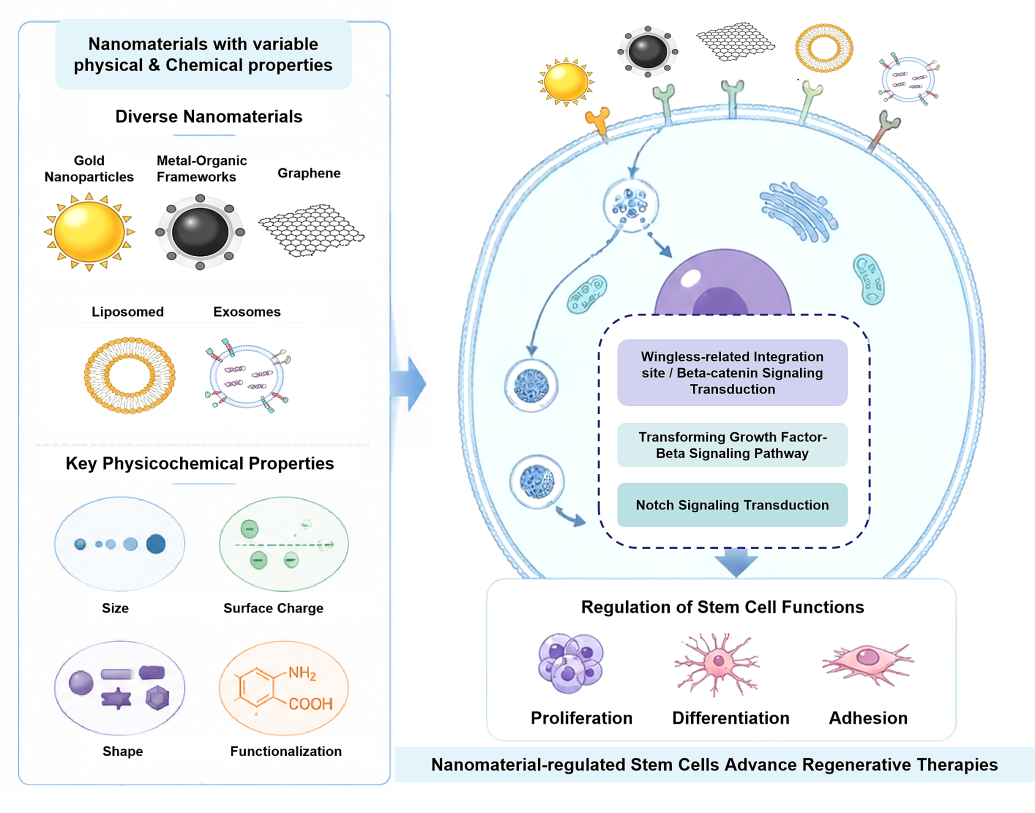
Stem cells possess self-renewal capacity and differentiation potential. Under appropriate conditions, they can continuously divide to generate more stem cells of the same type or differentiate into various specialized cell types, thereby contributing to the formation of diverse tissues and organs. In tissue engineering and regenerative medicine, stem cells serve as key elements for repairing or replacing functional tissues lost due to disease, injury, or aging. The development of nanomaterials has provided new tools and approaches for stem cell research, particularly in the biomedical field, where they are widely applied in drug delivery, biosensing, medical imaging, and tissue engineering. Moreover, through interactions with cell membranes and/or intracellular components, nanomaterials can modulate key stem cell functions — including differentiation, proliferation, and adhesion — thereby enhancing the therapeutic efficacy of stem cells in biomedical applications. This review first introduces the main characteristics and potential risks associated with the application of nanomaterials to stem cells. The subsequent section provides an overview of how nanomaterials regulate stem cell biological functions and activate associated signaling pathways, followed by a discussion of future directions and challenges in this field.